12 Days of Handstands
Community Funded Online Training Program
Home | Explore | Handstands | 12 Days of Handstands
About This Program
YogaSlackers 12 Days of Handstands is here to help you train handstands wherever you are, supported by a fun, dedicated online community around the world.
Below you’ll find this month’s training program. We update this page during the last days of each month, so if you want a heads-up when the new plan drops, join our newsletter.
For extra accountability (and a lot more encouragement), we also recommend joining our Facebook group to connect with other handstanders sharing the journey.
If you’d like to support this project, you can contribute $10 to $20 monthly, or with a one-time contribution via PayPal or Venmo. Your support helps us keep creating training plans, filming new videos, and offering feedback to the community.
And if you want something more tailored, ask us about personalized training programs, built around your goals and shareable with up to two friends who are working toward similar outcomes.
TRAINING PROGRAM

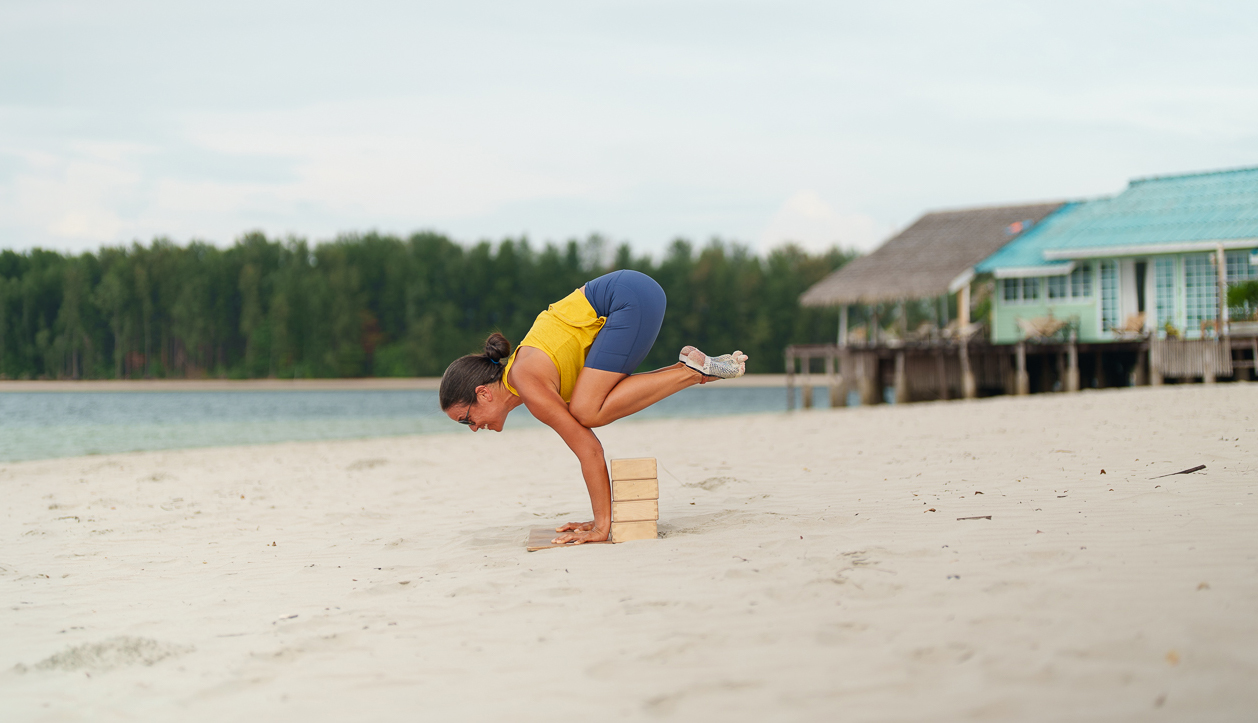
Crow Pose: A Pathway Toward Stronger Handstands | 12 Days of Handstands | April 2026
As I prepare for my classes at the Catskill Yoga Festival this July, I have been thinking a lot about how one practice supports another. slackline yoga, acroyoga, yoga, and handstands are not separate worlds to me. They are all connected.
Arm balances on the ground can become much more accessible when we improve our balance, body awareness, and confidence through slacklining or acroyoga. At the same time, the shapes and drills we use for handstands can directly support and strengthen our yoga practice.
My yoga practice changed immensely when I started practicing acro and slacklining. It became stronger, more balanced, and more inquisitive because I began looking at it through a different lens. I started asking myself: How should I practice this pose so I can do it on a slackline?
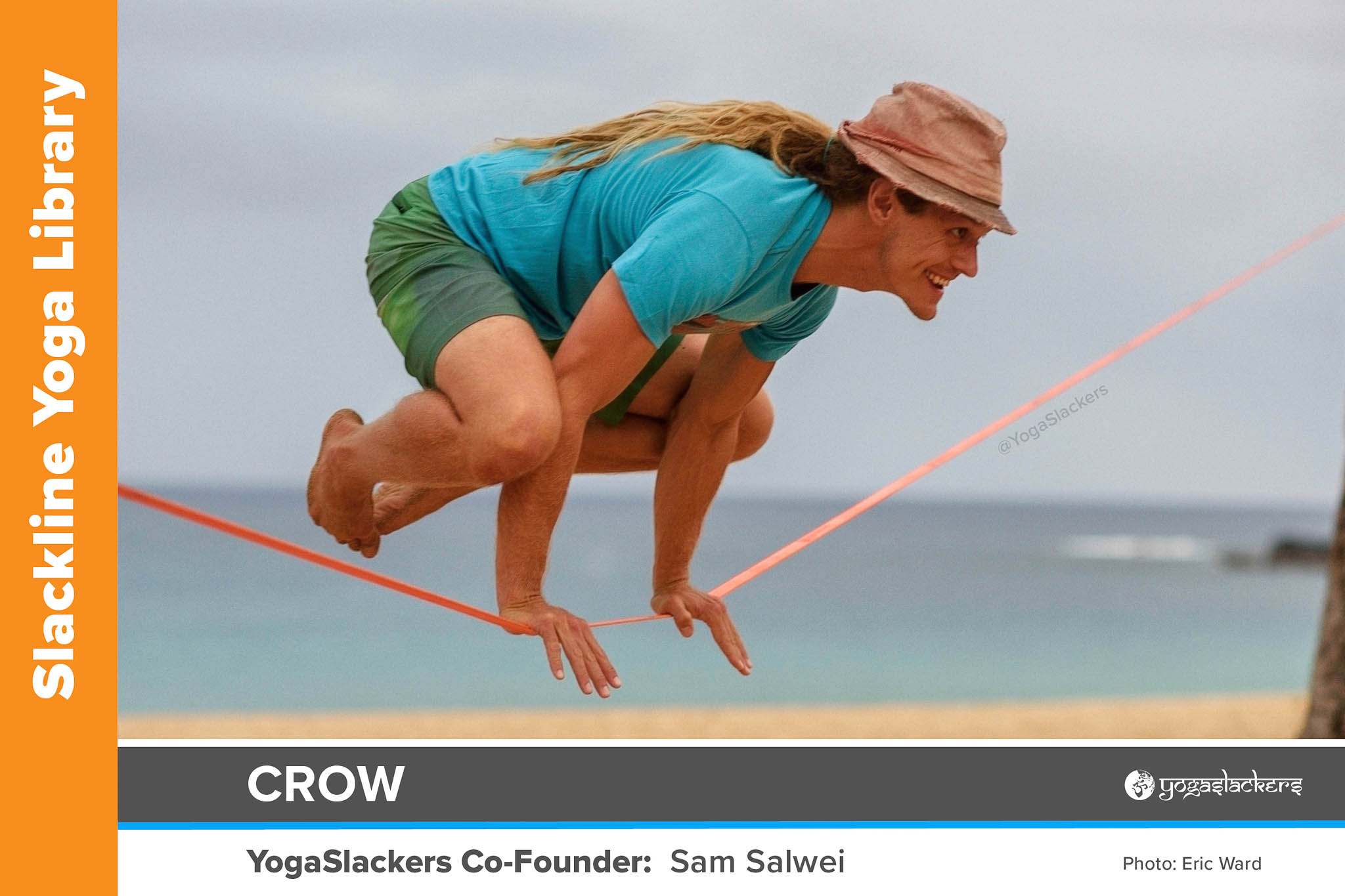
That mental process allowed me to dive deeper into the poses I was practicing on the mat and to break them down in a way that helped me find their inner structure.
In a similar way, when I practiced slackline yoga, I began wondering how I could practice to improve my acro and yoga practice. How I can use the line to make this pose easier in terms of effort, balance, and overall understanding.
And I have never stopped asking those questions!
Show me a new way to move, and I will ask the same thing. Now that we have been practicing a lot of kiteboarding, it is the same process. How can this new form of movement benefit my other movement practices? And how can I modify my other practices to support this one?
I think this is a natural process – as Yoga is not only about shapes or techniques – its aim is to quiet the mind, cultivate awareness, and help us return to a greater sense of connection within ourselves and with the world around us.
In a way, I am always looking for that union in everything I practice. Because it reminds me to find that same sense of union when I am not practicing too.
TRAINING SCHEDULE
Your daily practice:
- 1 minute plank
- 1 minute crow
- 1 minute headstand
- 1 minute handstand (or an alternative)
That is it!
Through this process, I want you to notice how these traditional yoga poses support your handstand journey. While they all share the obvious commonality of being hand balances or inversions, each one highlights something different. Your job this month is to explore those differences and discover what each pose has to teach you.
You can scale it however you need. You might do 10 seconds of each and build up over the month. You might choose just one of the four each day and hold it for 1 minute. But the real goal is simple:
Practice daily.
Why? Because if you are truly practicing yoga with the intention of finding union, then you can practice every day. 1 to 5 minutes is enough. Not all yoga practices need to be 90 minutes long! All it takes is a moment to stop, breathe, and reconnect.
Keep it approachable. Keep it consistent. And let the small daily effort add up.
Join us in New York
Additional Downloads
Recommended Tools
Practice your handstands on a wood board, hard carpet, or a thin yoga mat. This will help you absorb some of the pressure created on your hands while handstanding, without creating too much instability.
Avoid practicing on soft surfaces – such as thick carpets, puzzle mats or thick yoga mats – as the instability created by them can put your joints in compromised positions.
Nothing fancy is needed. I use a homemade 1/2 in (3.81 cm) plywood board.
Clear out some space around a wall or pillar in your home. Make sure to clear up enough space to create a safe fall zone in case you fall in any direction.
Remember to use your thin yoga mat or handstand board during your wall training drills.
We use yoga blocks to help us maintain proper forearm alignment. If you don’t have any, think outside the block and experiment using water bottles, books or boxes.
You will need to time the length of your handstands. It can be done with a friend and a chronometer or by trimming a video.
Here are a few of our favorite apps to time our handstands: M Stopwatch, Handstand Quest, and Seconds.
Handstand training like any other training stresses your body. Take time after each training session and between training days to massage your body.
We recommend Armaid and RAD rollers. Check out our resource page for discount codes for both.
The original challenge involves holding cumulative minutes. You will start a timer as soon as your feet leave the ground and stop the timer as soon as your feet return to the ground. During your next handstand you will continue the timer until you accumulate your desire time for the day.
Cumulative handstand holds are about ‘time on your hands’. Form and entrance style are not as important as holding your handstand.
There are two main ways to do this:
1) Practice one cumulative minute handstand per day of the month until day 12th.
Example:
Day 1, 1 cumulative minute.
Day 2, 2 minutes… all the way to
Day 12, 12 minutes.
2) Or spread the 12 days throughout the month. Keeping track of what day you are on.
If you choose to practice the original challenge, attempt all your handstands off the wall. You may use a spotter to avoid catastrophic falls, but if you touch the spotter or the wall, come down immediately and try again. Please not to use the spotter to hold the handstand longer than you can hold on your own.
This challenge is all about learning to enter a handstand and how to balance a handstand off the wall by practicing small movements. If you use a wall or a spotter to go up without control or if you touch the wall and continue holding the handstands then this challenge will be less effective.
If you feel like you need a spotter or a wall to enter the handstand, then we recommend you do not attempt this level yet, and instead attempt Level 1.
Level 1 drills are designed to help you become comfortable entering and exiting a handstand on the wall. The primary focus on this level is to learn:
- External rotation of the upper arm.
- Maintaining your arms straight during entrance, exits and handstand holds.
- Learning the hollow body position (ribs in, shoulders and hips opened).
- Learning the mechanics of entrances and exits.
- And becoming comfortable holding a handstand on the wall.
Stay on this level until you can hold 6x plank for 1 min in less than 12 minutes or until you can handstand off the wall for 5 seconds.
Level 2 Drills are about learning to be comfortable off the wall. While form is always important, perfectly straight off the wall handstands in this level are not the main goal.
However, on the wall, your goals is to have perfect form. Do not sacrifice your form for longer wall handstands. That defies the purpose of most wall drills. These drills are to improve your form, not the length of your wall handstands.
Stay in this level until you can hold a handstand off the wall for 15 to 30 seconds.
Level 3 drills are meant to help you have a longer, quieter and straighter handstand. Your goal at this level is to focus on quality of movement on and off the wall. Yes, we do want longer handstands, but stability and alignment comes first.
Focus on form and effective movement on wall handstands, entrances, exits and holds… in that order.
Stay on this level until you can hold a straight and quiet 1 minute handstand.
What after the 1 minute mark?
Then you will be able to work on leg isolations, asymmetric holds and increase your handstand hold to 2 minutes and one arm handstands (OAHS). However, will only take you to a 1 min, maybe a 1:30 goal.
If you would like more, contact Raquel for personalized training plans.
End each practice with meditation.
Explore how your core engagement helps you stay centered. Observe how the breath can create a shift in your center of gravity. See how you can modify your breath to take full breaths without rocking your body forwards and back. Then apply that change in your breathing pattern to your next handstand practice.
Just like in your handstand, it may be useful to video yourself from the side. This will allow you to see if you are leaning, curling or loosing your line in any way.
Slackline Gear
eLine Slackline Full Kit
- Select options This product has multiple variants. The options may be chosen on the product page
Arrowhead Ground Anchors
Oval Carabiner (locking)
Line Lock
Upcoming Events
YogaSlackers Teacher Training | Jan 8-21, 2027
Kaomai Lanna Resort, Chiang Mai, Thailand