

Travel Hack: How We Turn Everyday Spending into Free Vacations | Sponsored by Visa

We’ve been traveling the world for over 15 years now, and while we’ve had some amazing gear sponsors along the way, our real MVP sponsors are… credit cards. We joke that we’ve basically been “sponsored by Visa” for years.

That doesn’t mean we’re sitting on mountains of credit card debt or, on the flip side, that we have an unlimited budget. Far from it. What we do have is time, flexibility, and a slightly nerdy passion for learning how to stretch every dollar (and every point) as far as possible. 

In this blog, we’ll walk you through exactly how we do it: using airline loyalty programs, credit card sign-up bonuses, point hacks, and travel rewards.

But before we dive into the how, we need to start with the single most important rule: the rule that makes or breaks this entire system.

DISCLAIMER: This article is not to be used for financial advice. It’s simply what has worked for us in over a decade of full-time travel. Every person’s credit profile, financial situation, and travel goals are different, so always consult a professional and do your research to make decisions that are right for you.

This article contains affiliate links. If you apply for a card or service using these links, we may both earn extra points or bonuses, a win-win!

The Golden Rule for Credit Card Use

Let’s make this crystal clear: the system we are about to explain only works if you’re using the credit cards to pay for everyday expenses (thing you would be paying for anyway) and then paying it off in full at the end of the month.

We are not suggesting or encouraging anyone to get into credit card debt. If you end up in debt, the game is over. You lose and the credit card companies win.

The goal is to make the credit cards work for you, not the other way around.

Flexibility is also key. One of our favorite wins was taking a 4-day layover in Greece that knocked thousands of miles off our flight cost. Basically gifting us a free vacations.

We Joined an Alliance

We flew our parents to NYC and got a free upgrade to first class!
We warned them that it was unusual to get four people upgraded! But then we got the same upgrade of the way home.
Nothing like a 15 hr international 1st class free upgrade to 'ruin' traveling forever!

What feels like a lifetime ago, a friend let us in on this little secret about using credit card bonuses and points to snag free flights. Honestly, at first it sounded like a whole extra job we did not have time for, especially because some folks were juggling balances and interest, which was a no-go for us. So instead, Sam and I basically married one airline.

We opened a Delta Skymiles American Express Credit Card and committed to flying Delta almost exclusively. Our goal? Reach their highest status: Diamond Medallion. For years, we stuck with Delta even if the flights cost a bit more than other airlines.

Why Delta? Their credit card offered us unlimited lounge access, two free bags per person, and an annual companion ticket. Plus, being from Puerto Rico meant Delta waived the minimum spending requirement at the time, which made it a game we could actually win. 

Marrying Delta also meant marrying SkyTeam, their global alliance. That meant our benefits applied not only on Delta, but also on partners like KLM, Air France, Korean Air, Aeromexico, and more. That’s how we flew effortlessly through Europe and Asia with the same perks.

We eventually hit Diamond Medallion. Free upgrades, priority everything, heaps of free luggage, it made travel incredibly comfortable. But then the rules changed.

Maintaining our status became impossible. And we were forced to pivot to a new strategy: POINTS.

NOTE: We’re not going to dive deep into alliances here, just know that if you travel the same routes often, sticking to an airline alliance can be a great path. It takes more time, but if you can reach and maintain status (which requires traveling and spending a lot!), it’s totally worth it.

Unlocking Free Flights: The Welcome Bonus Game

Welcome bonuses is how we have been able to fly for (almost) free around the globe. To show you the power of this strategy, here’s what we did last year: We flew from the USA to South Africa, Zanzibar, Reunion Island, Mauritius, Madagascar, Singapore, Vietnam, Thailand and Taiwan back to the USA for $1,500. That included dreamy upgrades to lay-flat first-class seats on two 15-hour flights, all thanks to points. $1500 total for all those flights!

Instead of spending a fortune, we used about half a million miles and a small amount of cash to cover all those trips. Now, forget how many miles that took us, because what really matters is that you can earn those miles by using your credit cards to pay for your everyday expenses. Turning the money you are already spending into free-ish flights.

Think about where you can go for $1,500 per person just using cash!

Probably not far.

Before we played the credit card game... We flew standby. A good reminder that there are many ways to save cash while traveling.

Credit Card Bonuses in a Nutshell

Here’s the simplest way to understand the welcome bonus game:

Credit card companies offer big chunks of points (or miles) as a “thank you” for signing up. All you have to do is meet a minimum spending requirement in a determined amount of time.

The bonus generally range from 30,000 to 250,000 miles after making a single purchase to spending thousands of dollars in 1 to 5 months.

These bonuses are like a shortcut to a pile of points that would normally take a long time to earn. The trick is to pick the right cards, meet the spending requirements with your normal expenses, and then watch the points roll in. That’s the foundation of how we get those “free” flights.

And here’s an important note: these points aren’t the same as earning miles directly with one airline. Which is actually a good thing! With most credit card programs, the points you earn are flexible and can be transferred to a bunch of different airline partners. That means you’re not locked into one airline’s program. Instead, you can shop around to find the airline that offers the best deal on points for the flight you want. Then you transfer your points to that airline and book your flight with the airline directly.

In other words, credit card points are like having a universal currency for travel. You’re not married to one airline, you get to pick and choose the best option every single time. This not only lets you travel with far less cash out-of-pocket, but it also gives you huge flexibility. Many airlines allow flights purchased with points to be changed, modified, or even canceled with a full refund of both points and the cash you used to pay for the flight taxes. That kind of freedom is almost impossible to get when paying cash.

Enjoying the free upgrade in another international flight!
AcroYoga Long flag over Morocco
The first time we visited Morocco, we found an amazing one-way flight from the US for just 20,000 miles. But we couldn’t find an affordable ticket from Morocco to our next destination: Israel. Every search was spitting out prices around $1,500 per person.

After days searching, we realized we could fly Morocco to Rome for about $150, then Rome to Israel for roughly the same. On top of that, we snagged another 20,000-mile flight from Rome back to the U.S.

By simply adding Rome to the itinerary, we saved thousands of dollars per person. We spent a full week exploring Rome and still came out way ahead of what the original route would have cost us.

How to Get Hundreds of Thousands of Miles (Relatively) Quickly

The key to racking up hundreds of thousands of miles quickly is having a smart strategy based on your needs. 

Cards with Zero Anual Fee

  1. Open a credit card that has a zero annual fee and a good opening bonus. This lets you earn a welcome bonus without paying anything extra.

  2. Use your new card to pay for your everyday expenses. Anything that you are currently paying with other cards, cash or a debit card.

  3. Stop using that card, as soon as you reach the sign-up bonus, but don’t close it. 

  4. Open a new credit card and repeat the process to earn another bonus.

Cards with Annual Fees

  1. Search for offers that waive the fee for the first year or for card with additional bonuses that justify the annual fee (free luggage, access to lounges, discounts, etc)

  2. Use the card until you earn your bonus, and then; 

  3. Downgrade the card to a no-annual-fee credit card with the same bank.

    To avoid paying fees for another year, as soon as we open a credit card that has an annual fee, we add a reminder in our calendar to downgrade that card. When the card anniversary is approaching, we call the company and ask if they can waive the fee for a year, which sometimes they do. If they can’t, we ask them to downgrade the card. 

  4. Open a new credit card. 

We suggest downgrading credit cards, instead of closing the accounts.

Constantly opening and closing cards (known as credit card churning) can be a red flag for banks, but having many cards open is not necessarily harmful to your credit score. What does matter is your credit utilization, and we’ll talk about that in the next section.

The strategy is simple: open a card with a strong welcome bonus, use it only until you earn that bonus, then move on to the next one. Over time, this is how you can quickly and consistently build hundreds of thousands of miles without spending any more money than you are already spending. 

Special Rules to Keep in Mind

Credit Utilization

Credit utilization is one of the most important factors in your credit score, and it’s actually very simple once you understand it. It measures how much of your available credit you use in a given month. For example, if you have a total credit limit of $10,000 across all your cards and you spend $1,000, your utilization is 10%. Credit scores love low utilization, and anything under 10% tends to keep your score healthy, under 5% is even better.

This matters a lot when you’re playing the welcome bonus game because high utilization can drop your credit score fast, even if you’re paying everything on time. One great way to keep your reported utilization low is to pay your credit card bill before the due date, a few days before your statement closes. This way, the balance that gets reported to the credit bureaus is smaller, making your utilization look lower and healthier.

Credit Limits

While credit utilization is about how much credit you use, your credit limit refers to how much total credit is available to you across all your cards. Having a lot of credit available actually helps your utilization ratio because the more credit you have, the easier it is to keep your usage percentage low. However, when you start collecting many credit cards for welcome bonuses, it’s easy to end up with tens of thousands of dollars in available credit. That isn’t harmful to your credit score, but sometimes lenders may look at extremely high total limits and decide they don’t want to extend even more credit.

To avoid this issue, it can be helpful to lower the credit limits on cards you’re no longer using. For example, if you have ten credit cards with $15,000 limits each, lenders see $150,000 in available credit. But if you lower those unused cards to something like $500 to $1,000 each, your total drops significantly while still keeping your utilization low. Reduce the limit so your profile looks tidy and reasonable. It’s a small step that helps keep lenders comfortable and makes it easier for you to continue being approved for future welcome bonus cards.

Climbing the Credit Card Ladder

Another important rule that you need to keep in mind is to open credit cards ‘in the correct order’. Think of it as a ladder. Credit card issuers often have different tiers, and if you jump straight to a step on the tier, you can accidentally lock yourself out of the bonuses on the lower or higher tiers… it depends on the bank. 

For example, if you’re working with Delta’s Skymiles with American Express, you’d want to start with the Delta Skymiles Blue, earn that welcome bonus then open the Gold, followed by the Platinum and ending with the Reserve. Doing it in this order means you can collect a bonus at each tier. If you jump straight to the Reserve card, you will miss out on the bonuses from the lower-level cards entirely. However, Chase, requires you to use the ladder in the opposite direction. Start at the top and move downwards. 

In short, the order in which you apply matters. So map your strategy, to maximize the number of bonuses you can earn.

Spend Your Points Wisely

Once you’ve built up a nice stash of hundreds of thousands of bonus points you need to find the most affordable ways to use them. Points are like cash, and they can disappear very quickly if you end up purchasing flights without researching your best option.

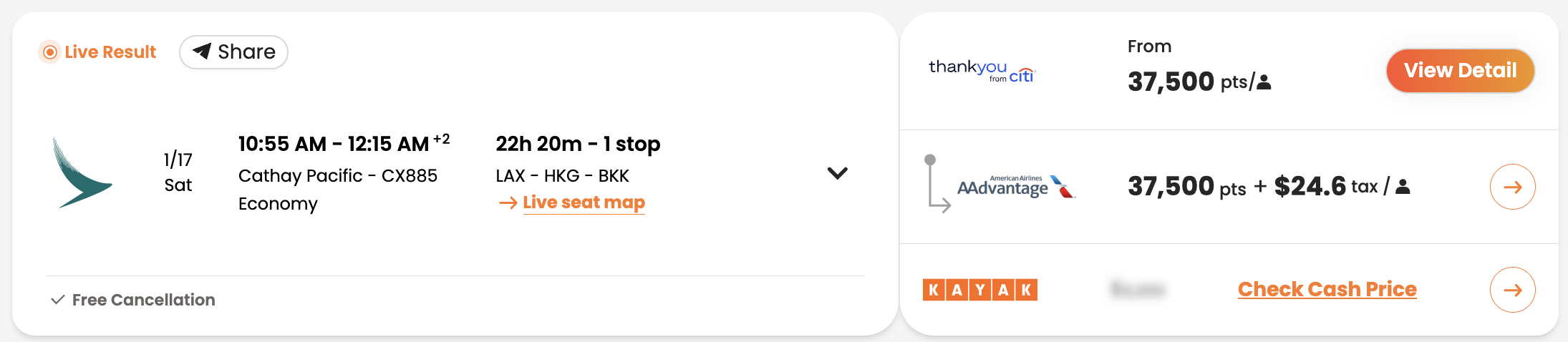
We use tools like PointsYeah to find the most affordable flight based on points and taxes to be paid and compare that with paying for the full flight with cash. It also shows which credit card programs transfer to a given airline. 

A points flight from LAX to BKK noting the cost in points (37,500) and the cash cost for taxes ($24.60). In this case you will need miles with American Airlines or to have points with Citi Cards that can be transferred to American Airlines.

For instance, we recently flew from LAX to Bangkok for $230, which would have cost us about 60,000 miles. In that scenario, paying cash was the smarter move for us.

Which Card Should you Start With?

This is the one question we can’t answer without knowing more about your travel plans. But we can help!

The best card for you completely depends on where you want to go. The easiest way for us to figure that out is to take a look at your upcoming travel goals. From there, we can quickly run a search for your routes and then plug those destinations into PointsYeah to see which airlines fly there and which credit card partners offer the best value. Once we know that, we look for the card with the strongest welcome bonus that fits your needs. And honestly, knowing what is or isn’t a good bonus takes a bit of experience.

For example, let’s say you want to join us in Puerto Rico for a traincation and you’re flying out of LAX or SLC. A quick search shows you can fly here for about 10,000 miles + $5.60 each way. Double that for a round trip. In that case, your best move would be opening the Citi® / AAdvantage® Platinum Select® card. It currently has $0 annual fee for the first year and offers 50,000 bonus miles after $2,500 in purchases in the first 3 months. More than enough to cover your entire trip.

But if your goal is to join us in Thailand for our Teacher Training, the math changes. Those flights tend to run around 50,000 miles each way, depending on the routing and search day. The good news is that these miles can be earned through flexible points from Chase,Capital One, or Citi, all of which transfer to airlines that fly to Thailand. So climbing any of those “card ladders” would be a great match for that trip.

The right card depends on the destination, and once you know where you’re headed, finding the perfect card is actually very easy.

Yeah...
It Still Sounds Like a Second Job

We get it. We avoided this path for a long time because it sounded way too complicated and time-consuming. But here’s the truth: it’s not nearly as overwhelming as it seems. And if a few hours of research can save you hundreds or even thousands of dollars, then honestly? That’s a pretty well-paying “second job.”

That said, you don’t have to figure this out alone. Just like we learned to slackline by watching others, asking questions, and breaking the process down into simple steps, we’re happy to do the same for you. If you want help choosing the right credit card strategy or figuring out the best approach for your travel goals, just send us an email. We’ll share everything we’ve learned so you can fly more, spend less, and skip the stress.

If you’re thinking about joining one of our events, whether it’s the Teacher Training in Thailand, the Thailand Retreat, or kitesurfing with us in Puerto Rico, definitely reach out. We’d be happy to hop on a call and walk you through how to get your flight for free (or close to it). If this system helps you join us for an adventure without breaking the bank, that’s a win we’d love to help you achieve.

Upcoming Events

No event found!
Load More
June 2026
July 2026
August 2026
January 2027
No event found!